The Evolution of Classic Car Sales - How Bring A Trailer Has Become the Market Leader


The on-line auction platform Bring A Trailer has a subscriber base of 1.4M and of those about 70,000 are in Canada. BAT has grown 500% since 2020, listing about 45,000 auctions in 2024, equating to $USD1.5B in sales volume. BAT’s numbers continue to rise, and appear to be only limited by their desire to keep the vehicle listings ‘BAT Worthy’. BAT is currently the largest collector car on-line sales platform in the world. This, from the humble beginnings of an enthusiast email list just a bit more than10 years ago.
To put it in perspective, all the auctions combined during the Monterey car week total about $400M annually. Barrett-Jackson sells about $200M of vehicles and merchandise during its Arizona sale and adds another $100M from auctions throughout the year in Palm Beach, Las Vegas and others.
How can we explain this, and how have collector car sales evolved over the years?
Collector cars, especially expensive ones, have always had a thin market, and required a wide distribution network to find a buyer. For 50 years after WWII selling them has mostly meant advertising in national print publications. Hemmings Motor News - the thick yellow newsprint magazine consisting of classified ads for vehicles and advertisements for suppliers was the ‘go to’ source for collector car shopping for decades. You could also find some interesting cars in the NY Times and LA Times classifieds. Road & Track magazine had several pages of classifieds in the 50’s through the 70’s ($10,000 Ferrari GTO anyone?). In Canada we had the local weekly newsprint publication ‘AutoTrader’ for regular cars, and the monthly ‘Old Car Trader’ which came out nationally.
There have always been physical auctions as well, and auctions dedicated to collector cars. Barrett Jackson was the big name with their annual Scottsdale AZ event in January, and there were many smaller regional auctions dotted around North America.
eBay was the first major disruptor starting in the late 1990’s. Buyers could now look at a hundred photos and a complete description of a vehicle, instead of a single grainy photo and a few lines of text in a magazine. You could look at the sellers feedback and eBay offered some buyer protection against fraud. Sellers could list a vehicle for $100 or so and sell the car from their garage, as opposed to paying a 10% sellers fee and having to transport the vehicle to a physical auction. Purchasers did not pay a buyers fee at all - typically 10-12% at a physical auction.
eBay basically gutted the small regional auctions and virtually all print advertisements for most collectibles, including cars.
In the early 2000’s email lists began to replace direct mail. With no restrictions on size, some classic car dealers began writing in-depth descriptions of collector cars, similar to what you might find in a high-end auction catalogue, but with more detail. Mike Sheehan from Ferraris On-Line and Bruce Trenery from Fantasy Junction in Emeryville, CA were early pioneers. They added not only hundreds of photos, but detailed descriptions and history of the vehicles as well.
At the same time enthusiast blogs began to grow in size and popularity. One could subscribe to weekly, or even daily emails, from a wide range of content providers. There were many on just about every type of classic car. Two popular ones were German Cars For Sale and Bring A Trailer. They would scan eBay, Craigslist and other classifieds and put together a list of cool cars that were for sale. They started to add reader comments to the blogs, inviting participation from their subscribers. On-line communities were created.
The 2000’s also saw the explosion of YouTube, with content creators of every kind. Many of the first viral videos were car related including Ruf’s famous Fazination, and Ken Block’s Gymkhana series. Car reviews moved on line. Chris Harris, Doug DeMuro, Jay Leno and others began to attract major subscriber bases for their car related content.
Car magazines started to see circulation dry up; like newspapers their print editions were just being pulped.
With more collector cars being sold on-line, and bought sight unseen, the standards for photography and detail increased. An automotive detailer turned broker, Dean Laumbach in NJ, began detailing and refinishing the undercarriages of vehicles as part of his eBay auctions. Dean had the knack of locating very low mileage 1980’s and 1990’s Mercedes and getting very strong prices for them. Dean was among the first dealers to devote as much time to the underneath of a vehicle as the top side.
Cryo-blasting (media blasting with dry ice) became a thing, and Dean and others used this technique to blast all the dirt from the bottoms of the cars and wheel wells - in many cases making the undercarriages look almost new again.
By 2014 Bring A Trailer had amassed a following of several hundred thousand subscribers. They then had the masterstroke of monetizing their subscriber base with on-line auctions. Instead of reporting on auctions or classifieds on other sites, they would host the auctions themselves. Without the costs involved with a physical auction they could offer a 5% buyers fee (then capped at $5,000 and since risen to $7,500) and nothing but a $100 listing fee for the seller. A typical fee structure for a physical auction would be a 10% seller’s fee and 12% buyer’s fee.
It was successful right from the start. BAT brought together several hundred thousand car enthusiasts on an auction platform with listings that featured several hundred photos, videos and invited commentary from their subscribers. The standard of preparation was very high and the auctions often featured vehicles that were highly detailed and well photographed. The commentators would ask questions and flush out details which helped to build confidence (or not) in the seller and listing.
Bring A Trailer had created what was very close to a perfect market - bringing buyers and sellers together with unprecedented levels of disclosure, documentation and transparency.
Seeing the inroads BAT was taking into the collector car auction space, RM Auctions reportedly made an offer for $100M for BAT - it was refused. BAT was later sold to Hearst Publishing for a reported $400M in 2020. If it were to be offered for sale again $1B would not be a ridiculous number, given that their revenue and listings have grown 500% since. This is a staggering number for a company that has less than 200 employees, most of whom work remotely.
This sent a shock wave through the entire collector car market.
Within a year, there were perhaps 20 well-financed collector car auction platforms started. These were started by established car magazines like Hemmings, internet content providers such as Doug DeMuro (Cars And Bids), marque specific sites like PCar Market (Porsche), and MB Market (Mercedes). Physical auction sites like RM, Gooding and Bonhams also launched on line sites. There were also many start ups.
The sites that had substantial traffic managed to succeed, while the start ups generally failed as they couldn’t generate the critical mass of buyers, sellers and vehicles.
New on-line collector car auctions continue to appear. Hagarty, the classic car insurance provider, bought a physical action (Broad Arrow which was created by ex-RM employees) and have launched on-line auctions. Luxury goods magazine duPont Registry launched one. Other collector car magazines have come to the conclusion that print is basically dead or dying, and have attempted survival by trying to monetize their subscriber base by auctioning cars on line.
Bring A Trailer is still the market leader, by a large margin, and they continue to innovate and expand. About 5 years ago we started to see collector cars shot with $25k Hasselblads in photo studios with professional staging and lighting. Pioneers like Matt Crandall (911r) started featuring fine art quality images and evocative driving videos as part of their Bring A Trailer listings. These practically jumped off the page, and sellers who invested heavily in photography and videography soon became extremely busy. Because they could afford to be choosy with what cars they represented, they started to dictate reconditioning standards so the vehicle’s condition matched the quality of the photographs. They soon had substantial reconditioning business to complement the commission they earned selling cars.
These ‘Super’; BAT sellers have built a brand for themselves. I had somebody tell me recently that 911r had 70 vehicles lined up to sell in their Arizona location. ‘911r’ and ‘1600veloce’ have completed more than 2000 auctions on BAT and ‘Wob’ is almost there. While it took BAT a while to sell their first $1M vehicle, now results in the $1M-$5M are commonplace. The traditional auction houses like Gooding & Co. and RM Sothebys, still have most of the over $5M market to themselves, but this is changing. The sales results that BAT achieves appear to be no different that what is realized in a fancy auction in Monterey, but buyer’s and seller’s fees on a $2M car are more than $400,000 at RM. BAT’s fee is capped at $7,500 for the seller, and fees to have somebody list a car on BAT range from 5%-8%, often matching BAT’s $7,500 cap. There may be older collectors who are not comfortable buying on-line, but this segment of the market is not increasing.
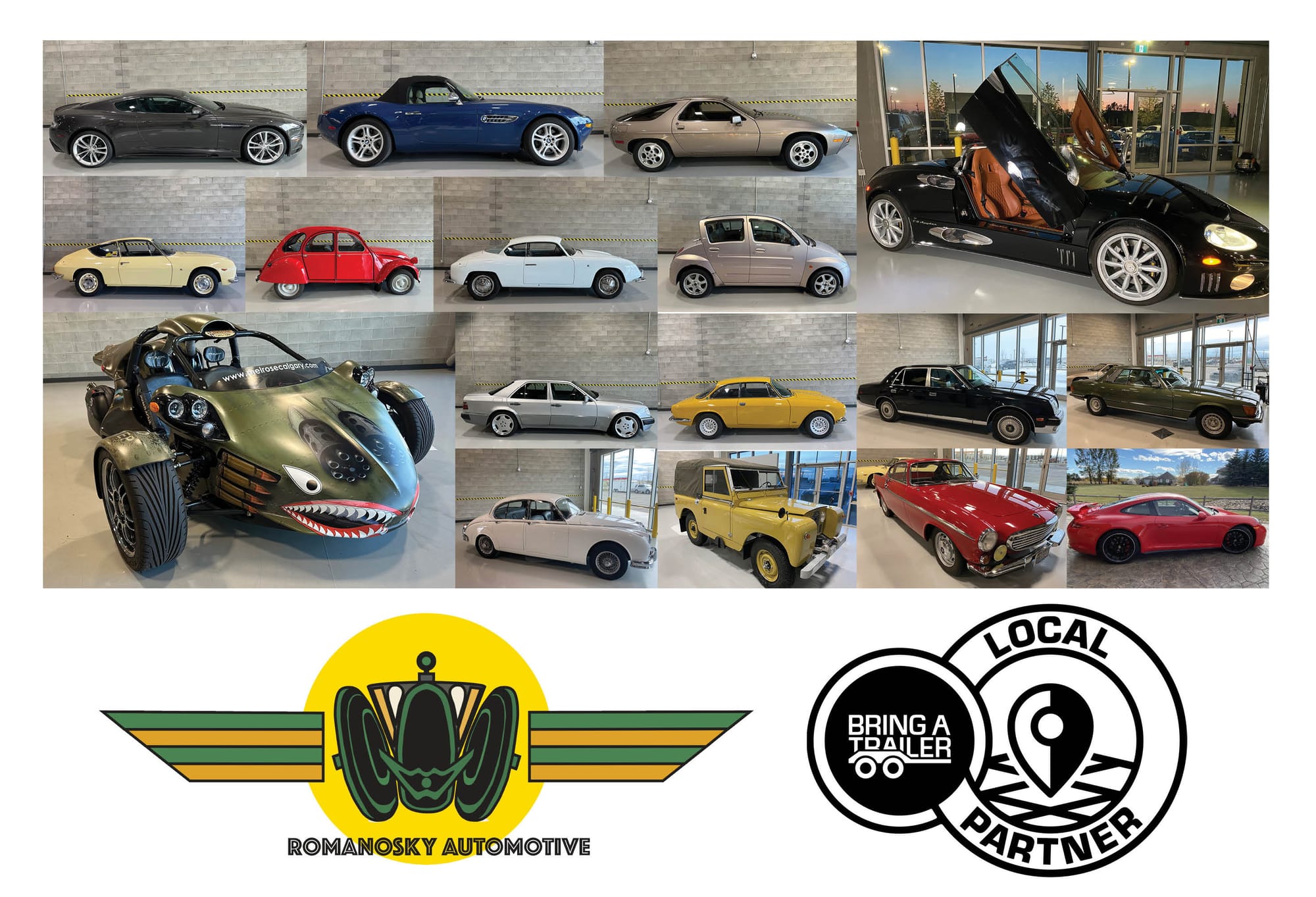
Bring A Trailer realized that the professionalism brought about by high quality listings was good for viewership and sale results so they have been building out a network of ‘Bring A Trailer Local Partners’. Romanosky Automotive is one 4 businesses in Canada so designated. These service providers help owners get their vehicles ‘sale ready’, and have the facilities and expertise to photo and video document vehicles to the standards now expected for on-line sales. The objectives of these detailed presentations is to give confidence to those buyers who will be buying the vehicle sight-unseen - sending money to someone they don't know often in another country.
While the standards for photography have risen dramatically, so too will videography. Walk around, cold start and driving videos are now the norm and they will get asked for very quickly by BAT commentators if they are not provided. Production standards still vary widely, but no doubt they will get better and better.
If I have added anything to this car collector space, it is with the 1 hour long narrated walk around videos that I do for my BAT listings. The format is to talk a bit about the vehicle in general, more about the particular car, then do an exterior walk around including paint meter readings, interior walk through, engine bay, trunk, undercarriage, cold start and finally driving. This results in a video up to 90min long, but is so comprehensive that there are very few questions during the auction. I’ve heard from many buyers that the only reason they.were prepared to bid was the thoroughness of the video. A one hour video takes about 10 hours of shooting and editing, so it is unique in the space at this time. As the benefits are very clear to me, I fully expect longer videos to become more commonplace.
The future of collector car sales is creating a community around all the best aspects of quality magazine photography and journalism, automotive video reviews, vehicle reconditioning including undercarriage detail, knowledgeable and detailed presentation, and coupling it with a reliable auction platform. That is what Bring A Trailer has managed to do better than any one else.
The future, as I see it, is more businesses like mine be popping up, affiliated with one or more auction sites, offering local services to sellers who want to sell their vehicles on-line. I see this trend crossing over to more mainstream vehicles as well. Simply, this is just a better way to buy and sell cars - offering more transparency and confidence to the buyer, and lower costs for everybody.
-Lawrence Romanosky
LAWRENCE ROMANOSKY
Phone: 403-607-8625
Email: Lromanosky@me.com


Comments ()